How to Master Camera Settings for Flawless Makeup Selfies
Learn how to master camera settings for flawless makeup selfies by optimizing ISO, shutter speed, aperture, white balance, and focus for perfect results.

Estimated reading time: 6 minutes
Key Takeaways
- Optimal camera settings (ISO, shutter speed, aperture, white balance, focus) remain important for capturing true-to-life makeup details with current devices.
- Using the right lighting environment and adjusting settings in Pro/Manual mode can improve your selfies beyond auto mode, even with AI-enhanced smartphone cameras.
- Common issues like overexposure, incorrect white balance, and noise can often be improved with simple tweaks, and many apps now offer real-time histogram and exposure warnings.
- Experimentation and keeping a settings log can help you discover your signature style and achieve consistently pleasing selfies, especially as camera technology evolves.
Table of Contents
- Why Camera Settings Matter for Makeup Selfies
- Define and Optimize Each Setting
- Step-by-Step Guide to Adjusting Your Camera Settings
- Smartphone vs. Digital Camera Settings
- Common Mistakes and How to Fix Them
- Practical Examples and Visual Comparisons
- Final Tips and Encouragement for Experimentation
- Conclusion and Call to Action
Why Camera Settings Matter for Makeup Selfies
Capturing your makeup's true colors and textures goes beyond application—it’s about understanding the settings that render every highlight and contour in its best light. With smartphone cameras integrating AI-driven enhancements and computational photography, having some knowledge of manual controls can help avoid overprocessed or unnatural results. From color accuracy to detail clarity, the right configuration can help your look appear authentic. Plus, synchronizing your camera with natural vs. artificial lighting setups balances shadows and preserves nuance. For lighting tips, see selfie lighting makeup tips.
Define and Optimize Each Setting
ISO (Sensor Sensitivity)
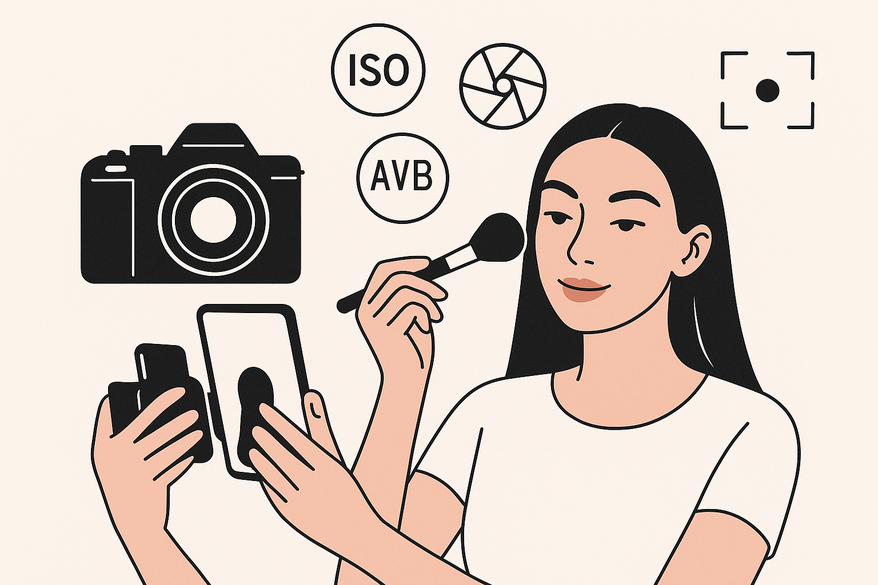
- Definition: ISO controls the sensor’s light sensitivity—lower values (100–400) generally minimize noise and highlight skin textures, which is beneficial for detailed makeup shots.
- Tip: ISO 100–400 is recommended in daylight; indoors or at dusk, you may raise it to 800, but higher values can introduce grain. Newer smartphone sensors often handle noise better, but manual control can still be helpful.
Shutter Speed (Freeze Motion)
- Definition: Shutter speed dictates exposure duration—too slow and you risk blur; too fast and you may underexpose.
- Recommended: Around 1/60–1/100 sec helps lock in subtle head movements for sharp selfies. Image stabilization improvements in recent devices may allow slightly slower speeds, but sharper is generally better for makeup detail.
Aperture (Depth of Field)
- Definition: Aperture (f-number) sets depth of field—wide apertures (e.g., f/2.8) can isolate your face with a blurred background.
- Benefit: Emphasizes makeup details—such as winged liner and cheek contour—while softening distractions. On smartphones, simulated aperture effects are common, but true optical aperture control on some cameras can yield better results.
White Balance (Color Accuracy)
- Definition: White balance calibrates color temperature so skin tones and pigments appear natural—avoiding unwanted color casts.
- Presets: “Daylight” outdoors; “Tungsten” or “Fluorescent” indoors.
- Manual: In Pro mode, adjust the temperature slider until foundation and blush look natural. Many apps offer real-time preview adjustments to assist.
- Explore the secret to flawless makeup in photos for more insights.
Focus (Sharpness)
- Definition: Focus zeroes in on your eyes or key makeup areas for clear detail.
- Tip: Tap the eye area on smartphones; use single-point or manual AF on DSLRs and mirrorless cameras for precision. Eye-tracking autofocus has improved in recent years, enhancing sharpness in selfies.
Step-by-Step Guide to Adjusting Your Camera Settings
Follow these steps, reviewing your preview and histogram after each to help achieve balanced exposure and natural color:
- Choose Your Lighting Environment (north-facing window or softbox; avoid direct midday sun). Consider using LED panels with adjustable color temperature for consistent lighting.
- Set ISO (100–400 in bright light; up to 800 indoors if needed). Some newer sensors may allow ISO 1600 with acceptable noise, but test your device.
- Adjust Shutter Speed (1/60–1/100 sec for sharp shots). Use image stabilization if available to reduce blur.
- Select Aperture (f/2.8–f/4 for shallow depth of field). On smartphones, use portrait mode with manual depth control if available.
- Configure White Balance (preset or manual slider). Use real-time preview to fine-tune.
- Lock Focus (tap eyes or use single-point/manual focus). Enable eye-tracking AF if supported.
- Check Exposure Compensation (+0.3 EV if makeup appears flat; monitor the histogram). Many apps now show live histogram overlays.
Smartphone vs. Digital Camera Settings
Smartphones: Use Pro mode for ISO, white balance, shutter speed, and exposure sliders—avoid beauty filters for accurate representation. Third-party apps like Adobe Lightroom Mobile or Halide offer advanced manual controls and RAW capture, allowing more flexibility in post-processing.
Digital Cameras: Switch to Manual (M) mode, pair with a fast prime lens (e.g., 50 mm f/1.8), and set a custom white balance using a gray card. Mirrorless cameras with eye-tracking autofocus and high-resolution sensors can provide excellent image quality and detail, making them suitable for makeup selfies.
Common Mistakes and How to Fix Them
- Overexposed/Washed-Out Makeup: Lower ISO or exposure compensation; watch highlight clipping. Use histogram to avoid blown highlights.
- Unnatural Skin Tones: Adjust white balance toward warmer or cooler presets; use manual temperature slider for precision.
- Soft or Blurry Details: Focus on the eyes; avoid digital zoom. Use a tripod or stable surface to reduce camera shake.
- Harsh Shadows & Hotspots: Use diffusers or reflectors for even light distribution; consider ring lights with adjustable brightness and color temperature.
- Grainy/Noisy Images: Keep ISO ≤800; add more soft light instead of boosting sensitivity. Use noise reduction software cautiously to preserve detail.
Practical Examples and Visual Comparisons
Create side-by-sides to highlight the impact of your adjustments:
- Auto vs. Manual/Pro mode
- Incorrect vs. Correct white balance
- High ISO vs. Low ISO
Caption each comparison with settings used (ISO, aperture, shutter speed, white balance). Consider using apps that allow split-screen previews to compare in real time.
Final Tips and Encouragement for Experimentation
- Customize settings for your face shape, makeup style, and environment—AI tools can sometimes suggest optimal settings based on prior shots.
- Keep a settings log in your Notes app or use dedicated photography journals to track combinations that work well.
- Use consistent backgrounds and angles to craft your signature look—find best angles makeup selfies guide for inspiration.
Conclusion and Call to Action
Mastering ISO, shutter speed, aperture, white balance, and focus can help you capture professional-looking makeup selfies anywhere. Try these settings today, share your results in the comments, and subscribe for more photography and beauty tips to stay current!
FAQ
- What ISO setting is best for makeup selfies?
Use ISO 100–400 in daylight to keep noise low. Indoors or in low light, you can raise it up to 800. Some sensors handle ISO 1600 well, but higher values may introduce grain. - How do I choose the right white balance for makeup photos?
Start with the “Daylight” preset outdoors and “Tungsten” or “Fluorescent” indoors. In Pro mode, adjust the temperature slider until your foundation and blush look natural. Real-time preview tools can help fine-tune this. - Why is aperture important for makeup selfies?
A wide aperture (low f-number) creates a shallow depth of field, isolating your face and emphasizing makeup details with a pleasing background blur. On smartphones, use portrait mode with manual depth control if available. - How can I avoid grainy makeup selfies?
Keep ISO at or below 800 and introduce more soft light (natural or diffused) instead of increasing sensitivity. Use noise reduction tools sparingly to maintain detail. - Should I use my smartphone or a digital camera for makeup selfies?
Both can yield excellent results. On smartphones, use Pro mode or advanced apps; on cameras, shoot in Manual mode with a fast prime lens and custom white balance. Mirrorless cameras with eye-tracking autofocus can offer high detail.