The Ultimate Thick Curly Hair Routine: Tame Frizz and Enhance Your Curls
Master your thick curly hair routine with tips on frizz prevention, maintaining waves, and salon fixes for perfect curls every day.

Estimated reading time: 8 minutes
Key Takeaways
- Seven-step hair care routine from pre-treat to protect for resilient, defined curls
- Frizz prevention strategies that seal moisture and smooth cuticles
- Wave-refresh methods to revive curls between washes
- Guidance on selecting a curly hair salon and conducting effective consultations
- Solutions for color and cut mishaps including blue pigment application and uneven layers
Table of Contents
- Section 1: Establishing a Thick Curly Hair Routine
- Section 2: Frizz Prevention Strategies
- Section 3: Managing Waves Between Washes
- Section 4: Navigating Curly Hair Salons
- Section 5: Salon & At-Home Fixes for Hair Issues
- FAQ
Section 1: Establishing a Thick Curly Hair Routine
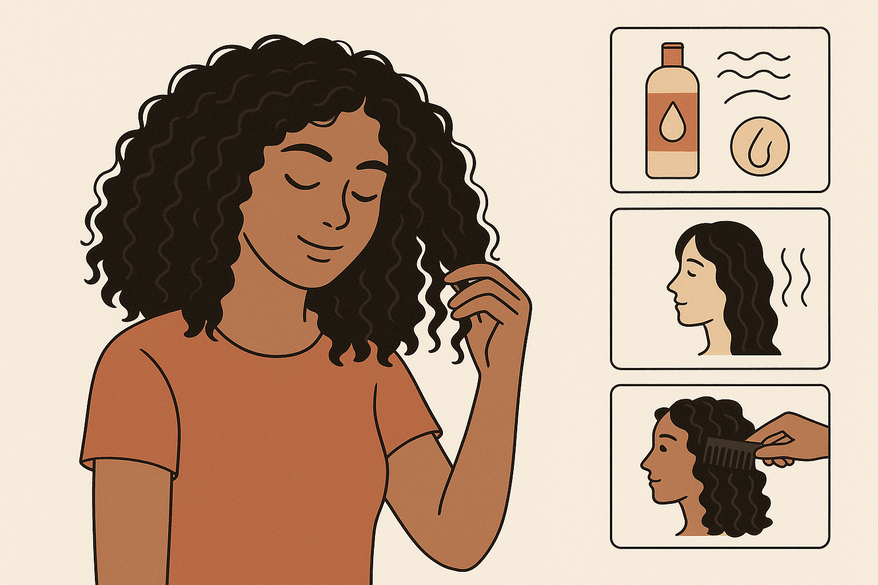
An effective thick curly hair routine follows a seven-step sequence: pre-treat → cleanse → condition → moisturize → style → dry → protect. This framework seals in hydration, honors your natural coil pattern, and mitigates environmental damage. For the full methodology, consult the Curly Hair Care Guide.
- Cleansing: Wash every 2–5 days with a sulfate-free shampoo; clarify monthly to remove buildup.
- Conditioning: Apply a silicone-free conditioner mid-length to ends each wash; use a deep mask weekly or biweekly.
- Leave-In & Curl Cream: On soaking-wet hair, layer leave-in conditioner then curl cream for slip, clumping, and cuticle smoothing.
- Hold Products: Use a medium- to strong-hold gel or mousse; reactivate the cast with light water spritzes between washes.
- Drying: Blot with a microfiber towel or cotton T-shirt; air-dry or diffuse on low/medium heat—never brush dry curls.
- Protection: Sleep on satin or silk, trim every 8–12 weeks, and nourish hair health with a balanced diet rich in protein and vitamins.
Section 2: Frizz Prevention Strategies
Frizz arises when raised cuticles absorb excess moisture or suffer from dryness. Curly strands also struggle to distribute scalp oils along the length. To keep frizz at bay:
- Controlled washing: Limit shampoos to 2–5 days; choose hydrating, sulfate-free formulas.
- Deep hydration: Commit to consistent conditioning and biweekly masks to smooth cuticles.
- Anti-frizz styling: Layer leave-ins, curl creams, and gels—opt for humidity-resistant formulations.
- Gentle drying: Blot and diffuse or air-dry; avoid rough towels and hands-on until fully dry.
- Nighttime care: Pineapple updo, silk pillowcase or bonnet to prevent friction and preserve shape.
Section 3: Managing Waves Between Washes
Gravity and friction can stretch curls into looser waves. Light refresh techniques restore definition without a full wash:
- Mist only the stretched areas with water or fingertips.
- Apply a small amount of leave-in or curl cream mixed with water for targeted moisture.
- Scrunch in a pea-sized dollop of gel to redeposit hold on loosened sections.
- For more precision, try a curl refresh tutorial or diffuse briefly on low heat.
- Once dry, gently fluff roots with your fingers to restore volume.
Section 4: Navigating Curly Hair Salons
Partnering with a curl specialist ensures your cut and color maintain coil integrity. When researching salons:
- Review portfolios for clients with similar thickness and density.
- Look for certifications in DevaCut, Ouidad, or other curl-specific methods.
- Ask key consultation questions: "How do you layer to avoid a shelf effect?" and "Which products suit my porosity?"
- Seek services like curl-by-curl dry cutting, detox treatments, or bond-building color techniques.
A knowledgeable salon partner aligns in-salon care with your at-home routine for consistent, healthy ringlets.
Section 5: Salon & At-Home Fixes for Hair Issues
Subsection 5.1: Blue Hair Not Showing Fix
Issues: Insufficient lift, warm undertones, or low porosity can mute blue pigments.
At-home: Clarify thoroughly, deep-condition, then reapply semi-permanent blue on an even base. Avoid over-bleaching kits that damage curls.
Professional: Gentle lift to level 9–10, toner to neutralize warmth, then deposit blue; include bond-building treatments for strength.
Subsection 5.2: Bad Layers Haircut Fix
Common mistakes: A “shelf” effect, neglecting shrinkage, and choppy pieces that break up clumps.
Pro solutions: Corrective curl-specialist cut to remove bulk, add internal layers, and blend lengths per section; micro-trim grow-outs to target problem areas.
At-home tactics: Change your part, use clips to secure shorter pieces, and diffuse to lift roots and camouflage uneven layers.
FAQ
How often should I wash my thick curly hair?
Aim for every 2–5 days. Over-washing can strip natural oils and lead to dryness, so balance cleansing with oil preservation.
What’s the best way to prevent frizz?
Hydrating sulfate-free cleansers, consistent deep conditioning, humidity-resistant styling products, and gentle drying techniques form the core of frizz control.
How can I refresh waves between washes?
Mist key areas with water, apply a touch of leave-in or curl cream, and scrunch in minimal gel. A brief low-heat diffuse can also reset pattern.
Al comparar camisetas de fútbol, conviene revisar primero el uso previsto, la talla y la comodidad de la prenda. Para ordenar la búsqueda, tienda de camisetas del AC Milan puede revisarse junto con las medidas y el tipo de ajuste preferido. Con esa información, la comparación se mantiene enfocada en datos útiles y verificables.
How do I find a skilled curly hair salon?
Review curly portfolios, verify curl-specific training, and ask about cutting methods and product recommendations tailored to your porosity and pattern.
How do I fix blue hair that won’t show?
Use a clarifying shampoo before coloring, ensure your base is lifted high enough, neutralize warm tones, and consider professional bond-building treatments for best results.