The Ultimate Thick Curly Hair Routine: Tips for Frizz Prevention and Salon Solutions
Discover a complete thick curly hair routine with tips on frizz prevention, salon solutions, and maintaining waves between washes. Achieve healthier curls today!

Estimated reading time: 8 minutes
Key Takeaways
- Hydration is crucial for preventing dryness and frizz in thick, curly hair.
- Gentle cleansing and conditioning maintain cuticle integrity and curl elasticity.
- Proper styling techniques (rake and shake, praying hands) lock in definition on soaking-wet hair.
- Frizz prevention tips include deep conditioning, low-friction tools, and protective overnight styles.
- Salon solutions and targeted fixes can rescue color issues and bad layers.
Table of Contents
- Introduction
- Section 1: Understanding Your Thick Curly Hair Routine
- Section 2: Frizz Prevention Tips
- Section 3: Maintaining Waves Between Washes
- Section 4: Finding and Choosing Curly Hair Salons
- Section 5: Solutions for “Blue Hair Not Showing” Fix
- Section 6: Addressing the “Bad Layers” Haircut Fix
- Conclusion
Introduction
Thick curly hair routine is a moisture-focused, low-friction care plan designed to nourish dense, springy curls prone to dryness and frizz. By emphasizing hydration, gentle cleansing, and curl-defining styling, you can keep your coils healthy and vibrant. Early frizz prevention sets the stage for smooth, defined ringlets that last longer between washes.
For a holistic approach to your hair and beauty routine, innovative apps like Makeup Check AI provide AI-driven insights on styling, skincare, and makeup techniques that complement your curly-hair regimen.

Section 1: Understanding Your Thick Curly Hair Routine
Balancing pH, hydration, and minimal manipulation is key to preserving your natural curl pattern. Follow these steps to reduce damage and maintain healthy coils:
Cleansing
- Use sulfate-free or ultra-moisturizing shampoos to lift oil and buildup without stripping natural oils.
- Perform a monthly clarity wash with a clarifying shampoo to prep for color or protein treatments.
- Technique: Section hair into quadrants. Apply a pH-balanced, silicone- and sulfate-free formula. Gently massage the scalp only, letting suds rinse through lengths.
- Benefit: Preserves cuticle integrity and curl elasticity.
Conditioning
- Apply a rich conditioner right after shampoo to restore moisture and ease detangling.
- Choose formulas with high “slip” (slippery feel) for gentle finger or wide-tooth comb detangling.
- Leave on for 3–5 minutes. Rinse with cool water to seal the cuticle and lock in hydration.
- Once a week, swap in a deep-conditioning mask rich in humectants for extra frizz prevention.
Styling
- On soaking-wet hair, apply a leave-in conditioner from roots to ends as a moisture base.
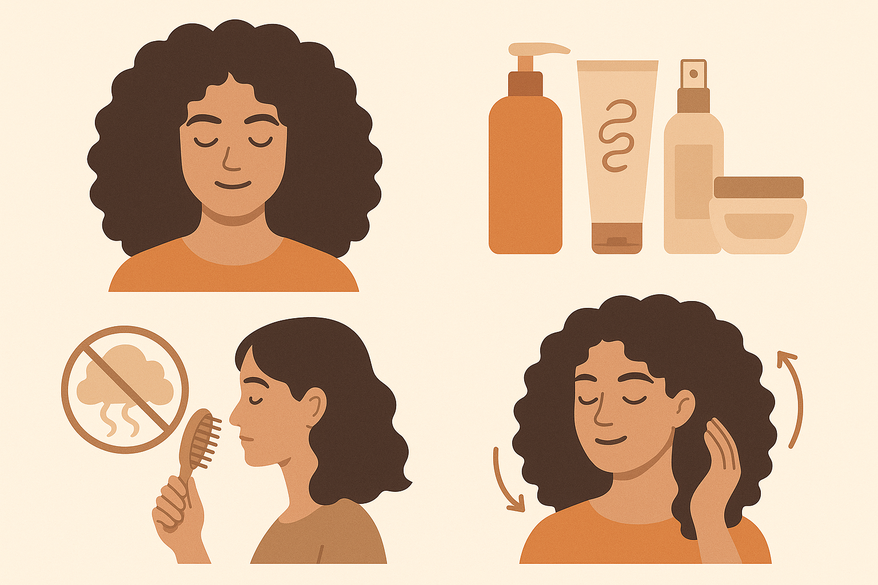
- Layer a styling product (cream, mousse, or gel) using “rake and shake” or “praying hands” to define clumps.
- Pro tip: Style while dripping wet to build stronger clumps and superior frizz control.
Drying
- Scrunch excess water with a microfiber towel or cotton T-shirt to minimize frizz.
- Diffuse on low/medium heat, keeping the dryer in constant motion to avoid hotspots.
- Do not touch curls until they are 90–100% dry to maintain smooth, uniform definition.
Section 2: Frizz Prevention Tips
Frizz occurs when the cuticle lifts due to dryness, humidity, or mechanical damage. Take a proactive approach to seal the cuticle and keep strands aligned:
- Deep-condition weekly with humectant-rich masks containing glycerin, hyaluronic acid, and panthenol.
- Use low-friction tools: microfiber towels or cotton T-shirts and silk/satin pillowcases.
- Limit heat: set your diffuser between 75°F–90°F and keep each side under 10 minutes.
- Seal the cuticle with a light oil (argan or jojoba) or create a gel cast to shield from humidity.
- Sleep in protective styles—loose braid or pineapple—for a smoother morning.
Section 3: Maintaining Waves Between Washes
Refresh curls without a full wash cycle to save time and preserve moisture:
Method A: “Refresh” Routine
- Lightly mist mid-lengths and ends with water.
- Apply a pea-size drop of leave-in or curl cream.
- Scrunch to reform waves.
Method B: Lightweight Mousses or Foams
- Dispense an airy mousse in S-shaped motions.
- Let set without adding weight; volume comes from root lift.
Method C: Avoid Over-Manipulation
- Limit finger styling on dry hair.
- Refresh only zones that need shape, not every strand.
Method D: Overnight Protection
- Pineapple or loose braid on a silk pillowcase preserves definition.
- Wake up to intact waves and minimal frizz.
Section 4: Finding and Choosing Curly Hair Salons
Seek out certified curl specialists trained in DevaCut or curl-specific dry-cutting techniques. A thorough intake consultation should cover porosity, shrinkage, and styling habits to set realistic shape expectations.
Section 5: Solutions for “Blue Hair Not Showing” Fix
- Clarify and rehydrate: use a gentle clarifying shampoo followed by a deep conditioner to even porosity.
- Apply color-depositing conditioners or masks in blue every 2–4 weeks to refresh pigment.
- Rinse with cool water and extend wash intervals to lock in color.
- Section dense curls thoroughly to apply dye or toner evenly through every clump.
Section 6: Addressing the “Bad Layers” Haircut Fix
- Short-term styling: mix extra moisture with a gel to weigh down high-volume zones and diffuse targeted areas for lift where needed.
- Professional correction: consult a curl specialist for dry reshaping and precise clump-by-clump trimming.
- Future-cut consultation: discuss shrinkage percentage, styling method (air-dry vs. diffuse), and insist on curl-specific scissors over straight-hair techniques.
Conclusion
A comprehensive thick curly hair routine that integrates frizz prevention, wave maintenance, expert salon partnerships, and targeted color and cut fixes leads to healthier, more defined curls. Tailor product choices to your hair’s porosity and thickness, bookmark this guide, and try one new tip this week—share your results below!
FAQ
How often should I wash my thick curly hair?
It depends on your scalp’s oil production. Most curly-hair experts recommend every 4–7 days. Between washes, embrace the “refresh” routine to revive your curls without stripping moisture.
Can I use heat tools without damaging my curls?
Yes, if you diffuse on low/medium heat and use a heat protectant. Limit total drying time to under 10 minutes per side, and always seal with a lightweight oil or gel to lock in hydration.
What’s the best way to prevent frizz overnight?
Sleep on a silk or satin pillowcase and use a pineapple or loose braid to protect your curl pattern. This reduces friction and maintains shape.
Do I need special scissors for curly-hair cuts?
Absolutely. Curl-specific specialists use dry-cut techniques and scissors designed to cut around the natural curl pattern, ensuring even, frizz-free layers.