Makeup for Mature Skin: A Complete Guide to Radiant, Youthful-Looking Skin
Discover how to apply makeup for mature skin, addressing concerns like fine lines and age spots with hydration-first techniques for a radiant complexion.

Estimated reading time: 8 minutes
Key Takeaways
- Hydration-first approach: Prep with serums, moisturizers and SPF for a smooth base.
- Creamy, lightweight formulas: Choose liquid foundations, blendable concealers and dewy primers.
- Targeted techniques: Use highlighters, color correctors and buildable products to soften lines, folds and dark spots.
- Integrate skincare & makeup: Layer products in upward motions and allow absorption for a more youthful finish.
- Expert tools: Leverage AI-driven reports from Makeup Check AI for personalized feedback.
Table of Contents
- Understanding Mature Skin Concerns
- Makeup for Mature Skin – Key Strategies
- Addressing Specific Makeup Challenges
- Skincare Routines for Mature Skin
- Integrating Makeup and Skincare
- Conclusion
- FAQ
Understanding Mature Skin Concerns
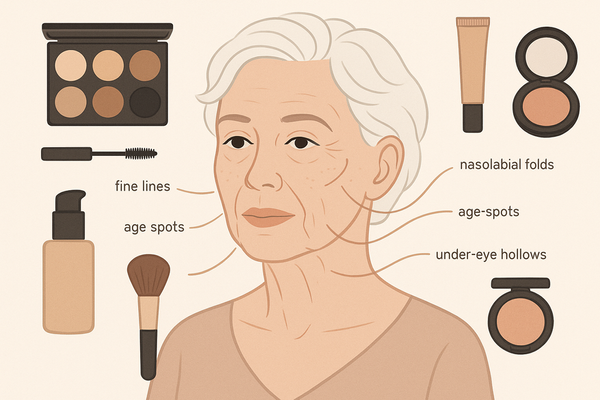
Mature skin—typically defined as 40+ years—undergoes changes such as loss of elasticity, fine lines, dryness and pigment shifts. Reduced collagen and slower cell turnover cause texture irregularities, while medical treatments can strip natural oils.
- Loss of elasticity and firmness
- Fine lines, deep wrinkles and nasal folds
- Increased dryness and flakiness
- Age spots and uneven pigmentation
- Heightened sensitivity after chemo or radiation
Why These Changes Occur
With age, collagen production declines and dead cells build up, leading to dullness and patchy makeup application.
Impact of Chemo Radiation Dry Skin
Cancer therapies often remove protective oils, resulting in redness, irritation and accentuated texture.
Hydration-First Approach
Restoring moisture is key: start with a hyaluronic acid serum, follow with a rich moisturizer and seal with a calming facial mist to prime skin for flawless foundation.
Makeup for Mature Skin – Key Strategies
Foundation Selection
- Opt for lightweight liquid foundations with skin-nourishing ingredients like encapsulated serums.
- Consider tinted SPF formulas for sheer, hydrating coverage.
- Match your shade precisely and blend evenly; for even blending tips, focus on thin layers.
Concealer Tips
- Use creamy, blendable concealers formulated for mature skin.
- Apply concealer after foundation to cover only needed areas.
- Blend with a damp sponge or fingertip for a seamless finish; see glowy routine or everyday tips.
Glow Enhancement
- Apply hydrating primers or dewy balms to reflect light without oily shine; explore top primer picks.
- Cream highlighters in champagne or pearl create a subtle, youthful radiance.
Addressing Specific Makeup Challenges
Fine Lines Skincare Routine

Pre-Makeup Prep
- Use a gentle cleanser to maintain natural oils.
- Apply a hyaluronic acid serum to bind and attract moisture.
- Follow with a lightweight, plumping moisturizer.
Exfoliation
- Incorporate a mild chemical exfoliant (e.g., lactic acid) once or twice weekly to smooth texture.
Primer & Foundation
- Start with a dewy primer to blur fine lines.
- Layer a light, buildable foundation in thin coats for natural coverage.
Nasolabial Folds Makeup
- Place cream highlighter on cheekbones and just above folds to lift shadows.
- Blend a buildable cream foundation or bronzer upward to soften deep lines.
Under Eye Hollows Makeup
- Neutralize darkness with a hydrating color corrector.
- Pat a lightweight concealer over foundation and blend gently for luminosity.
- Highlight the brow bone with a cream product to lift the eye area.
Skincare Routines for Mature Skin
Chemo Radiation Dry Skin
- Hyaluronic acid serum to attract and hold moisture.
- Nourishing balm (e.g., Jones Road Miracle Balm) to seal hydration.
- Continuous mist or glazing milk for on-the-go moisture boosts.
- Choose fragrance-free, sensitive-skin formulas.
- Finish with a broad-spectrum SPF to protect compromised skin.
Age Spots Routine
- Vitamin C serum and niacinamide to fade dark spots.
- Mild AHAs for gentle exfoliation and cell turnover.
- Use a tinted SPF foundation to naturally blur pigmentation.
- Layer a creamy concealer on persistent spots for targeted coverage.
Integrating Makeup and Skincare
- Cleanse – Gentle, non-stripping cleanser.
- Hydrate – Apply hyaluronic acid serum; wait 1–2 minutes.
- Moisturize & Protect – Follow with moisturizer and SPF.
- Prime – Use a dewy balm or hydrating mist on dry areas.
- Base – Apply foundation in thin layers; build where needed.
- Conceal & Correct – Dot color corrector, then concealer; blend with a damp sponge.
- Enhance Features – Cream blush, highlighter, brows, liner and mascara.
- Set & Finish – Mist lightly; dust powder only in T-zone if desired.
Layering Tips
Allow each product to absorb fully before the next. Use upward and outward motions to uplift and sculpt.
Conclusion
Makeup for mature skin hinges on a hydration-first philosophy, creamy formulations and targeted techniques for fine lines, folds, under-eye hollows, dry patches and age spots. By integrating expert-recommended skincare—gentle cleansing, serums and barrier-repairing moisturizers—with lightweight cosmetics, you can achieve a radiant, youthful complexion. Experiment with these routines and share your tips to inspire others on their age-defying journey!
FAQ
- How do I prep mature skin before makeup?
Start with a gentle cleanser, follow with a hydrating serum and rich moisturizer, then mist before applying primer. - Which foundations work best for mature skin?
Look for lightweight, dewy or satin-finish liquids with skin-nourishing ingredients and buildable coverage. - How can I minimize the appearance of fine lines?
Use a smoothing, hydrating primer and apply foundation in thin layers, avoiding powdery formulas that accentuate texture. - What’s the best way to cover age spots?
Combine a tinted SPF foundation with targeted creamy concealer and gentle exfoliation in your skincare routine. - Can I use makeup if my skin is very sensitive post-radiation?
Yes—choose fragrance-free, gentle formulas and focus on hydration and barrier repair before any color products.