The Ultimate Thick Curly Hair Routine: From Frizz Prevention to Salon Success
Discover a comprehensive thick curly hair routine that covers frizz prevention, finding top curly hair salons, and solving styling challenges for better results.

Estimated reading time: 10 minutes
Key Takeaways
- Personalized Routine: Nourish and define your unique curl pattern.
- Frizz Control: Step-by-step tactics to lock in moisture and seal cuticles.
- Salon Selection: How to find and vet curl-specialist stylists.
- Refresh Techniques: Maintain waves between washes without heat damage.
- Color Challenges: Fix fading or uneven blue tones in curly hair.
- Cut Corrections: DIY hacks and professional fixes for bad layers.
Table of Contents
- Introduction
- 1. Understanding Thick Curly Hair
- 2. Frizz Prevention Techniques
- 3. Finding the Right Curly Hair Salons
- 4. Achieving Waves Between Washes
- 5. Solving Color Challenges: Blue Hair Not Showing Fix
- 6. Fixing Bad Layers Haircut
- Conclusion
- FAQ
A thick curly hair routine is a personalized regimen designed to nourish, define, and protect voluminous curls. In this guide, you will learn how to tackle frizz prevention, maintain waves between washes, choose top curly hair salons, fix blue hair not showing issues, and correct a bad layers haircut fix.
For personalized feedback on how your styling techniques complement your overall look, tools like Makeup Check AI can analyze your routines and offer tailored suggestions.
1. Understanding Thick Curly Hair
Keyword: thick curly hair routine
What Is Thick Curly Hair?
- High-density strands: your hair has more fibers per square inch.
- S- or Z-shaped curls: springy coils that bend back and forth.
Key Hair Traits
- Porosity – how well hair absorbs and holds moisture.
- Density – count of hair strands on your scalp.
- Elasticity – how much hair can stretch and bounce back.
Why Balance Moisture and Protein?
- Too much moisture = limp curls.
- Too much protein = stiff, dry hair.
- Ideal routine mixes humectants, proteins, and oils.
Research Insight
High porosity hair benefits from humectants to lock in water. Source: Healthline
2. Frizz Prevention Techniques
Keywords: frizz prevention, thick curly hair routine
What Is Frizz?
Frizz happens when cuticle scales lift and moisture causes hair fiber swelling. It steals shape and shine.
Frizz Prevention Step-by-Step
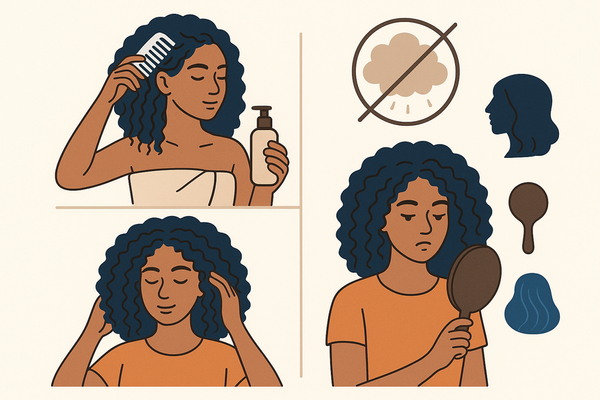
- Pre-wash Detangle
- Use a wide-tooth comb in the shower.
- Apply conditioner to ease knots.
- Cleanse
- Choose a sulfate-free, low-pH shampoo.
- Preserve natural oils and reduce cuticle lift.
- Condition
- Rinse then re-apply a rich, silicone-free conditioner.
- Focus on mid-lengths and ends.
- Leave-In Treatment
- Use a protein-moisture balanced cream.
- Distribute evenly through damp hair.
- Seal with Oil
- Lock in moisture with lightweight oil: argan or jojoba.
- Rub a few drops between palms, then scrunch.
Key Ingredients for Frizz Control
- Glycerin – draws moisture in.
- Shea butter – seals cuticles.
- Panthenol (pro-vitamin B5) – boosts shine and strength.
Styling Tips
- Plopping: wrap hair in a cotton T-shirt to shape curls.
- Diffusing: use a low-heat, cool-shot setting on your blow dryer.
Research Insight
Sulfate-free cleansers reduce frizz by up to 30%. Source: NaturallyCurly
3. Finding the Right Curly Hair Salons
Keyword: curly hair salons
Salon Selection Criteria
- Certified Stylists: look for DevaCut or Curly Girl Method training.
- Dry-Cutting Expertise: hair is cut when dry, curl by curl.
- Product Knowledge: they use curl-safe, silicone-free lines.
Questions to Ask Before Booking
- What curl types do you specialize in?
- Can I see a portfolio of your curly cuts?
- Do you have client testimonials or reviews?
What to Request During Your Appointment
- Curl-by-curl Shaping: tailor the cut to each curl group.
- Layer Balance: avoid pyramid shapes and bulk at ends.
- No Brushed-Out Styles: keep curls intact.
Pitfalls to Avoid
- Over-thinning: leads to frizz and loss of fullness.
- Chemical Straightening: never proceed without clear consent.
Research Insight
80% of clients report better curl definition after a curl-centric cut. Source: AAD
4. Achieving Waves Between Washes
Keywords: waves between washes, frizz prevention
Wash-Day Frequency
Every 3–5 days: lets natural oils nourish curls without greasiness.
Refreshing Methods
- Water-Based Spritz: mix water with leave-in conditioner in a spray bottle.
- Light Gel Scrunch: apply a pea-sized curl reviver gel to damp spots.
- Pineapple Updo: gather hair on top of your head in a loose bun overnight.
Mistakes to Avoid
- Product Overload: too much styling product weighs down curls.
- Excessive Heat: straighteners and curling irons damage cuticles.
Research Insight
Refreshing with water plus a lightweight conditioner extends style life by two days. Source: Allure
5. Solving Color Challenges: Blue Hair Not Showing Fix
Keywords: blue hair not showing fix, thick curly hair routine
Why Color Fade Happens
- High Porosity Hair: cuticles are open, dye bleeds out.
- Low Porosity Hair: cuticles are tight, repelling color molecules.
Pre-Color Prep
- Clarify: remove build-up with a gentle clarifying shampoo.
- Protein Filler or Porosity Equalizer: use Olaplex No. 3 or similar.
Dye Application Tips
- Section in 1-inch Panels: ensures full saturation.
- Apply from Roots to Ends: paint dye thoroughly.
- Process Under Heat Cap: gentle warmth opens cuticle for deeper penetration.
Post-Color Care
- pH-Balancing Shampoo: restores cuticle seal after dyeing.
- Color-Deposited Conditioner: use weekly to refresh blue tones.
Quick At-Home Remedy
Mix semi-permanent blue dye with clear conditioner. Apply to faded spots, leave on 10 minutes, rinse gently.
Research Insight
Heat helps open cuticle for deeper color penetration. Source: Allure
6. Fixing Bad Layers Haircut
Keywords: bad layers haircut fix, curly hair salons
Identifying Bad Layers
- Pyramid Effect: hair flares out at ends.
- Frizz Boost: uneven lengths lift and poof.
- Jagged Cuts: random short pieces.
DIY Styling Hacks
- Curl-by-Curl Twist-Outs: twist small sections around your finger to smooth jagged edges.
- Deep-Conditioning Masks: apply a rich mask to weigh down errant pieces temporarily.
Professional Interventions
- Curl-Specialist Corrective Cut: visit a salon that offers dry-cut precision.
- Point-Cutting Technique: stylist snips ends at an angle to soften layers.
Research Insight
Dry-cutting curly hair ensures shape is retained when dry. Source: NaturallyCurly
Conclusion
By following this thick curly hair routine, you can master frizz prevention, find top curly hair salons, maintain waves between washes, fix blue hair not showing issues, and correct bad layers haircuts. Everyone’s curls are unique—test products, track results, and adjust to your needs.
Share your own tips for a thick curly hair routine in the comments below. Ready to refine your overall beauty regimen? Discover personalized insights with Makeup Check AI today!
FAQ
- How often should I deep condition my thick curly hair?
Aim for once a week to replenish moisture without overloading your strands. - Which ingredients should I avoid?
Steer clear of sulfates, drying alcohols, and heavy silicones that can weigh down curls. - Can I color-treat and still maintain curl health?
Yes—prep with protein fillers, use pH-balancing shampoos, and follow with color-depositing conditioners. - How do I fix uneven layers at home?
Try curl-by-curl twist-outs or a temporary deep-conditioning mask, then seek a professional dry-cut for lasting results.