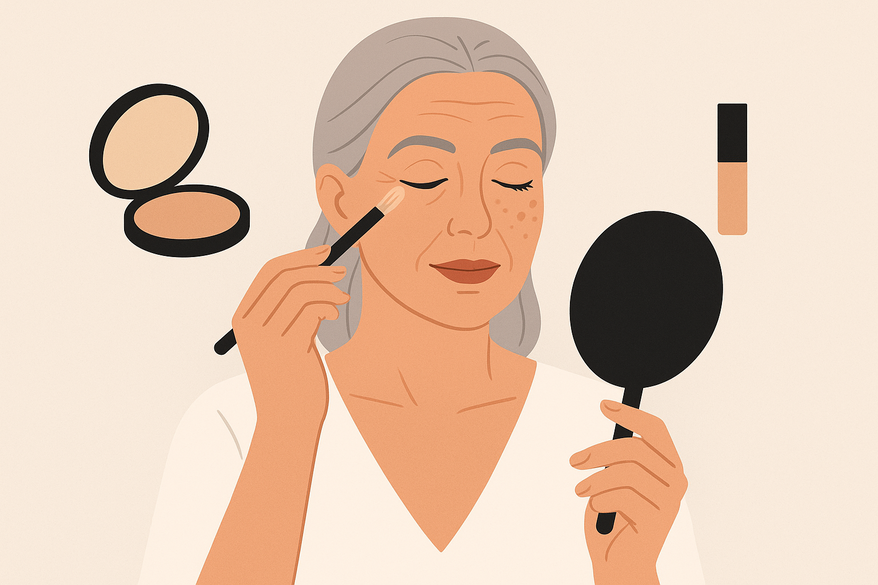
Makeup for Mature Skin: A Holistic Guide to Radiant, Youthful Complexion
Discover expert makeup tips for mature skin, including strategies for fine lines, under eye hollows, and age spots to achieve a youthful glow.

Estimated reading time: 8 minutes
Key Takeaways
- Hydration is key: Choose dewy, light-reflecting formulas that smooth and plump.
- Targeted skincare: Routines for fine lines, chemo-induced dryness, and age spots create a flawless base.
- Specialized makeup techniques soften under-eye hollows and nasolabial folds for a lifted appearance.
- Combining skincare and makeup enhances barrier support and ensures long-lasting glow.
- Avoid common pitfalls like over-powdering and heavy matte products that emphasize texture.
Table of Contents
- Understanding Mature Skin
- Skincare Strategies
- Makeup Techniques and Tips
- Combining Skincare and Makeup
- Expert Tips & Common Mistakes
- Conclusion
- FAQ
Understanding Mature Skin: Insights
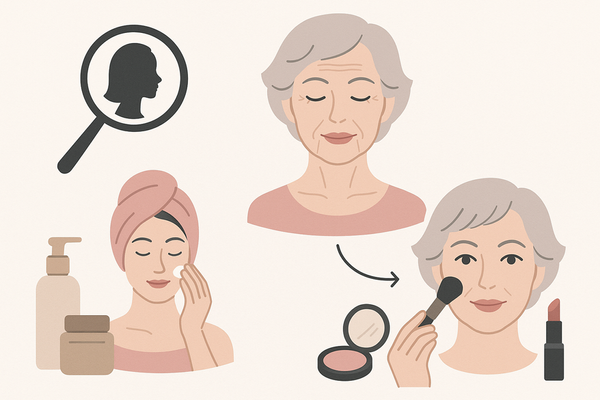
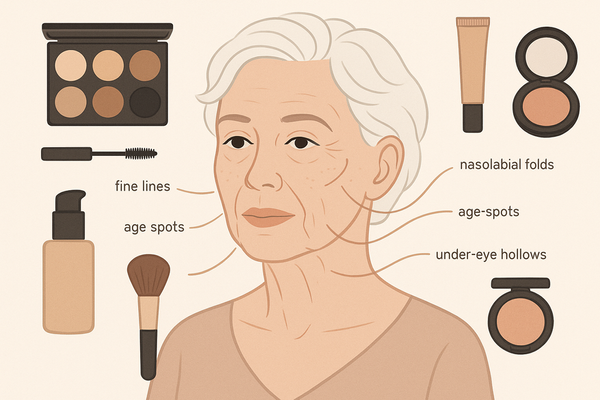
Mature skin undergoes structural changes—thinner epidermis, reduced collagen and elastin—and loses moisture retention and volume, accentuating fine lines, rough patches, folds, and hollows. Generic matte formulas tend to settle into creases, whereas hydrating, luminous products with light-diffusing particles blur imperfections and impart radiance. Insights from Women.com and Beautyblender.
Skincare Strategies: Makeup for Mature Skin Concerns
A. Fine Lines Skincare Routine
Key Ingredients:
- Hyaluronic Acid: attracts and holds water for intense plumping.
- Peptides & Ceramides: support collagen production and barrier repair.
- Gentle Retinol Alternatives (Bakuchiol or Micro-Encapsulated Retinol): boost cell turnover with minimal irritation.
Step-by-Step Routine:
- Cleanse with a gentle, pH-balanced formula.
- Apply hyaluronic acid serum on damp skin.
- Lock in moisture with a peptide/ceramide-rich cream.
- Use broad-spectrum SPF 30+ each morning.
- Optionally, prime with a silicone-based plumping primer.
B. Chemo Radiation Dry Skin
Chemotherapy and radiation can compromise the lipid barrier, leading to severe dryness and sensitivity. Repair first, then apply makeup for comfort and an even finish.
- Ceramide-Rich Creams to restore lipids.
- Fragrance-Free Glycerin/Hyaluronic Serums for non-irritating moisture.
- Avoid AHAs/BHAs until the barrier recovers.
- Overnight occlusive masks (petrolatum or squalane) to seal hydration.
Apply on damp skin, layer serums under creams, and skip harsh exfoliants. Source: Women.com, Beautyblender.
C. Age Spots Routine
Sun-induced hyperpigmentation calls for consistent brightening to fade existing spots and prevent new ones.
Key Ingredients:
- Vitamin C Serum for antioxidant brightening.
- Niacinamide to regulate melanin.
- Azelaic Acid or gentle acids to fade dark patches.
Routine Steps:
- Morning: Vitamin C serum → SPF 30+.
- Evening: Niacinamide or azelaic acid treatment → moisturizer.
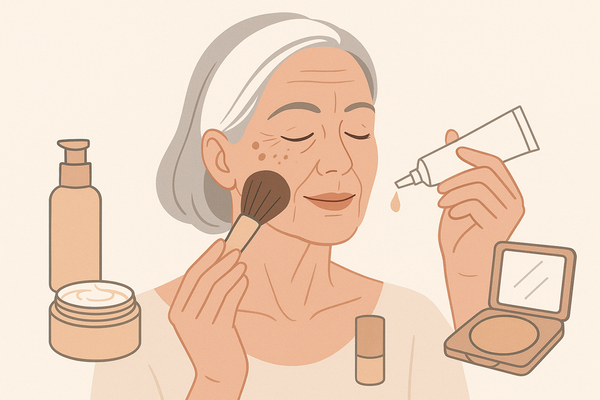
In-Makeup Camouflage: Use a lightweight, buildable concealer or foundation to even tone without caking. Learn more at Artdeco.
Makeup Techniques and Tips
A. Foundation Strategy
- Prime with a hydrating, silicone- or serum-based formula.
- Choose a lightweight, luminous liquid foundation with buildable coverage.
- Blend with a damp beauty sponge or synthetic brush.
- Set sparingly—focus on the T-zone to avoid a flat, creased finish.
For product picks, visit Makeup Check AI's guide.
B. Nasolabial Folds Makeup
Softening Technique:
- Apply cream contour beneath cheekbones in a soft “3” shape.
- Blend cream blush upward toward the temples.
- Highlight cheekbone apex, avoiding the fold itself.
- Diffuse edges with a damp sponge for a natural lift.
C. Under Eye Hollows Makeup
Concealing Method:
- Neutralize shadows with a warm peach or yellow color corrector.
- Layer on a hydrating, illuminating concealer (ideally SPF-infused).
- Tap gently with a small flat brush, then blend edges softly.
- Skip heavy powder under the eyes to prevent creasing.
See detailed techniques at Makeup Check AI eye guide.
Combining Skincare and Makeup
A unified routine ensures makeup enhances skincare benefits—hydration, barrier support, and brightening—while sitting smoothly on the skin.
- Cleanse → Tone with a hydrating mist.
- Apply treatment serums (hyaluronic acid, vitamin C, ceramides).
- Moisturize and allow 1–2 minutes to absorb.
- Prime with a plumping, luminous formula.
- Layer foundation and blend with a sponge.
- Conceal under eyes and age spots lightly.
- Contour and highlight nasolabial folds and cheekbones.
- Set only where needed with micro-fine powder.
Dual-purpose picks: hyaluronic acid-infused foundations, SPF concealers, peptide-boosting primers.
Expert Tips & Common Mistakes
Expert Advice:
- Opt for cream-based blush and bronzer to maintain dewiness.
- Use tools—sponges and brushes—for hygiene and precision.
- Incorporate SPF into primers, foundations, and concealers.
- Build coverage with multiple thin layers rather than one heavy coat.
Common Pitfalls:
- Over-powdering, which emphasizes texture and lines.
- Full-coverage matte foundations that settle into wrinkles.
- Skipping moisturizer or primer, leading to patchy application.
- Using harsh ingredients (parabens, sulfates) that worsen dryness.
Conclusion
Integrating targeted skincare routines—fine lines, chemo radiation dryness, and age spots—with light-reflective, hydrating makeup techniques for under-eye hollows and nasolabial folds delivers a seamless, youthful finish. Experiment to discover what suits your skin best, track your results, and embrace your glow.
For personalized guidance, virtual try-ons, and AI-driven analysis, explore Makeup Check AI.
FAQ
- Q: What foundation finish is best for mature skin?
- A: Choose a lightweight, luminous finish—avoid heavy matte formulas that can accentuate lines.
- Q: How can I prevent makeup from settling into fine lines?
- A: Prep with a hydrating primer, build coverage in thin layers, and set only where necessary.
- Q: How often should I update my skincare routine?
- A: Adjust seasonally or when you notice changes in hydration, texture, or pigmentation.
- Q: Is it okay to use color correctors under concealer?
- A: Yes—apply a peach or yellow corrector to neutralize shadows, then follow with a hydrating concealer.