Localized Makeup Recommendations AI: Personalized Beauty Advice for Every Region
Explore how localized makeup recommendations AI delivers personalized, region-specific beauty advice, catering to climate, culture, and unique individual features.

Estimated reading time: 8 minutes
Key Takeaways
- Localized AI tailors beauty advice to individual features and geographic factors like climate and culture.
- It uses machine learning, computer vision, and data analytics to analyze skin tone, environment, and trends.
- Benefits include improved shade matching, reduced returns, greater inclusivity, and higher customer satisfaction.
- Brands gain precise market segmentation, cost savings, and faster trend-driven product launches.
- Future developments will focus on privacy safeguards, bias mitigation, and hyper-accurate biometric integrations.
Table of Contents
- Understanding Localized Makeup Recommendations AI
- The Importance of Localization in Makeup Recommendations AI
- How Localized Makeup Recommendations AI Works
- Benefits and Advantages of Localized Makeup Recommendations AI
- Real-World Applications and Case Studies of Localized Makeup Recommendations AI
- Challenges and Future Perspectives for Localized Makeup Recommendations AI
- Conclusion
Understanding Localized Makeup Recommendations AI
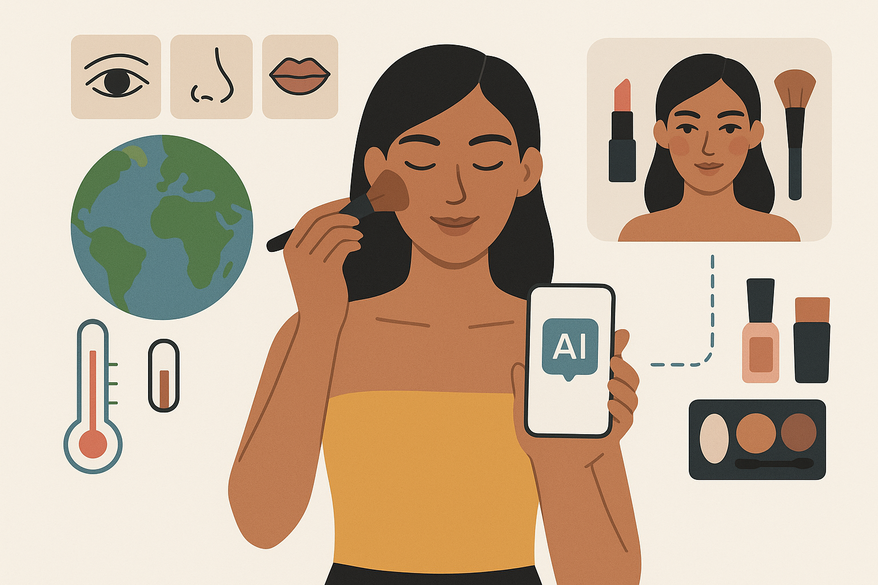
Localized makeup recommendations AI refers to systems that craft beauty advice by combining individual features—skin tone, undertone, facial geometry—with regional factors like climate, culture, and local trends. Consumers now expect shade matches and style tips that honor their unique identity and environment.
Makeup Check AI leverages user selfie scans and regional trend analytics to deliver hyper-personalized shade and style suggestions. Explore Makeup Check AI to see how localized AI recommendations can transform your beauty routine.
- Regional Demographics
– Uses census and marketplace data to map local skin tone ranges and undertones. You can refine undertone detection with tools like skin-tone analyzer.
– Captures common facial geometries and heritage-influenced features. - Climate and Environment
– Incorporates humidity, UV index, pollution, and temperature to recommend oil-control or hydrating formulas.
– Adjusts product textures based on local weather patterns. - Cultural Aesthetics
– Scans social-media hashtags and influencer styles to identify desired finishes (e.g., dewy, matte). Trend analytics often rely on AI beauty trend analytics to stay current.
– Learns regional color palettes—bold hues in Latin America, minimalist palettes in Japan.
Key Technologies
1. Machine Learning
– Supervised models train on labeled images of local users and their favorite products.
– Unsupervised clustering reveals hidden segmentations in regional preferences.
– Continuous learning adapts to seasonal shifts and emerging micro-trends. (See personalized makeup recommendations AI and custom makeup matching AI revolution)
2. Computer Vision
– Facial landmark detection pinpoints cheekbones, jawline, and eye shape for precise product placement.
– Skin tone and undertone classification algorithms analyze high-res selfies under controlled lighting.
3. Data Analytics
– Aggregates local product reviews to score favorite formulas by region.
– Scrapes Instagram, TikTok, and forums to detect trending shades.
– Integrates climate databases for environment-aware recipes. (See international makeup style AI)
The Importance of Localization in Makeup Recommendations AI
Localization goes beyond translation by tuning beauty advice to the interplay of skin, weather, and culture. Localized makeup recommendations AI excels by addressing three core factors:
- Regional Skin Tone Variation
• South Asia often features golden to deep brown undertones.
• Scandinavia’s lighter complexions include cool pink and neutral undertones.
• Middle Eastern regions show warm olive and amber tones. (Source: international makeup style AI) - Climate Influences
• Tropical zones demand oil-control primers and long-wear mattes for high humidity.
• Arid regions require hydrating serums, rich foundations, and sunscreen-driven SPFs.
• Temperate climates see variable needs—light hydrating BB creams in spring, fuller coverage in winter. - Cultural Preferences
• East Asia’s “glass skin” trend favors luminous, dewy finishes and cushion compacts.
• European markets often prefer classic matte sophistication and subtle contouring.
• North America embraces bold palettes, expressive brows, and inclusive shade ranges.
Why One-Size-Fits-All Fails
Generic makeup algorithms yield high return rates among underrepresented groups. Broad shade-match systems hit only ~70% accuracy, often misidentifying undertones. Brands lose revenue on returns and suffer brand trust erosion when customers feel overlooked. (Source: custom makeup matching AI revolution)
How Localized Makeup Recommendations AI Works
Localized makeup recommendations AI relies on a multi-phase pipeline combining user data, local insights, and global style repositories.
Data Collection Phase
1. User Profiles
– High-resolution facade scans capture skin texture, blemishes, and undertone.
– Questionnaires gather skin concerns, product history, and satisfaction ratings.
– Demographic details (age, ethnicity, lifestyle) enrich personalization. (Source: personalized makeup recommendations AI)
2. Local Insights
– Social-media sentiment analysis flags trending colors, finishes, and influencer tutorials.
– Regional product reviews reveal local favorites and pain points.
– Beauty blogger and salon data highlight emerging micro-trends. (Source: international makeup style AI)
3. Environmental Data
– Weather APIs track temperature, humidity, UV index, and pollution levels.
– Geographic seasonality informs formula adjustments—higher SPF in sunny regions, richer creams in cold zones.
Recommendation Generation Pipeline
1. Data Ingestion & Normalization
– Merges user, local, and global datasets into unified feature sets.
– Applies data cleaning to remove outliers and ensure balanced representation.
2. Model Application: Deep Localized Makeup Transfer Networks
– Synthesizes a “before” facial image with reference styles or regional looks.
– Uses style-transfer techniques to preview eye-shadow placements, lipstick finishes, and blush intensities. (See Deep Localized Makeup Transfer Networks and ACM style-transfer research)
3. Comparative Analysis
– Ranks products by shade-match score, climate compatibility, and trend alignment.
– Balances global best-sellers with local niche favorites.
– Generates a personalized report: top foundation matches, curated eyeshadow palettes, and local skincare boosters.
Algorithms & Continuous Learning
• Deep Neural Networks detect 68 landmarks for pinpoint makeup mapping and classify skin attributes.
• Predictive analytics forecast preferences based on past behavior and regional clusters.
• Feedback loops use user ratings and return data for ongoing accuracy improvements. (Source: custom makeup matching AI revolution)
Benefits and Advantages of Localized Makeup Recommendations AI
For Consumers
• Improved Accuracy: AI-powered shade matching achieves up to 95% accuracy versus ~70% for manual quizzes. (Source: personalized makeup recommendations AI)
• Higher Satisfaction: Customized recommendations cut product returns by 30–40%. (Source: custom makeup matching AI revolution)
• Inclusivity & Diversity: Supports underrepresented tones and culturally resonant finishes. (Source: international makeup style AI)
• Convenience: Virtual try-on simulators and downloadable shopping lists streamline purchases.
For Brands & Retailers
• Enhanced Segmentation: Region-specific insights power targeted campaigns and personalized landing pages. (Source: international makeup style AI)
• Reduced Returns & Cost Savings: Accurate recommendations lower reverse logistics by up to 25%.
• Market Innovation: Early detection of micro-trends accelerates new product development and localized packaging.
Real-World Applications and Case Studies of Localized Makeup Recommendations AI
Virtual Try-On Platforms
AR-enabled retailers integrate localized AI into apps, offering region-specific eye-look tutorials—resulting in 20% higher click-through and 15% more add-to-cart conversions. (Source: custom makeup matching AI revolution)
Region-Specific Product Launches
A Western brand analyzed Japanese and Korean social-media trends via international makeup style AI and cross-cultural beauty trends AI, then launched a pastel eyeshadow palette to U.S. consumers—selling out 35% faster than prior releases.
Hypothetical App Scenarios
• Tokyo Summer App: Recommends ultra-lightweight BB creams with SPF 50+ and pastel peach blushes for humid climates.
• Stockholm Winter App: Prioritizes emollient foundations, full-coverage concealers, deeper berry lip hues, and cream blushes to counter cold, dry air.
Reported Outcomes
Companies report 25–40% fewer returns, 30% higher customer retention, and 50% faster new-product adoption. (Source: custom makeup matching AI revolution)
Challenges and Future Perspectives for Localized Makeup Recommendations AI
Challenges
• Data Privacy & Security: Handling biometric scans and personal profiles under GDPR, CCPA, and other regulations. (Source: personalized makeup recommendations AI)
• Algorithmic Bias: Underrepresentation of rare skin tones requires diverse training sets and fairness audits.
• Continuous Data Updates: Automated pipelines from social media and sales platforms ensure real-time trend adaptation. (Source: international makeup style AI)
Future Innovations
• Biometric Sensor Integration: Embedding hydration and oil-level sensors in devices for hyper-accurate formulas. (Source: personalized makeup recommendations AI)
• Cross-Cultural Style Blending: AI mixing global trends based on user taste profiles. (Source: international makeup style AI)
• Fairness-Aware Models: Dynamic algorithms to maximize diversity and inclusion. (Source: custom makeup matching AI revolution)
Conclusion
Localized makeup recommendations AI merges individual features with local factors—skin tone distributions, climate data, and cultural trends—to deliver hyper-personalized beauty guidance. Consumers enjoy better shade matches, fewer returns, and culturally resonant looks, while brands benefit from precise segmentation, reduced costs, and faster trend-driven product launches. Embrace localized makeup recommendations AI today to unlock a new era of inclusive, region-specific beauty excellence.
FAQ
- What is localized makeup recommendations AI? It’s an AI-driven system that combines personal features and regional data—climate, culture, demographics—to provide tailored beauty advice.
- How does it gather regional insights? By analyzing census data, environmental metrics, social-media trends, product reviews, and local expert inputs.
- What technologies power these recommendations? Machine learning models, computer vision algorithms, data analytics, and continuous feedback loops ensure accuracy and relevance.
- What benefits do consumers experience? Higher shade-match accuracy, reduced returns, inclusive options for diverse tones, and personalized, culturally aligned suggestions.
- How can brands implement localized AI? By integrating user-scanning features in apps, leveraging weather and trend APIs, and employing region-specific data pipelines.